








1. Smaller memory.
We store the same information in 61% less space: 3,549 bytes instead of 9,092, with every item recovered exactly. Less to store means less to move, and moving data is a big part of what a computer's power goes to.
NEOMORPHIC™ is pioneering a revolutionary computing architecture built to shatter the limitations of modern AI, unifying Ultra Super Intelligence, holographic memory, exact recall, and extraordinary computational efficiency to usher in an entirely new era of computer science.
00 NEOMORPHIC™ · Efficiency Advantage
We store the same information in 61% less space: 3,549 bytes instead of 9,092, with every item recovered exactly. Less to store means less to move, and moving data is a big part of what a computer's power goes to.
Every trip data takes from one memory or chip to another costs power. Power spent moving data is roughly amount of data × number of trips. Shrink the data by 61% and halve the trips, and the power spent moving it falls by about 80%.
For every 10 watts used to make decisions, NEOMORPHIC can make the same decisions with as little as 4.5 watts.
Analog Data Sensors feed Signal Conditioning and Edge Analog Computing Cores, which map signals into a Virtual Frequency Space, Phase Relationships and Harmonic Resonance, all converging on the Central Intelligence Hub.
01 Next-Generation Computing Architecture
The next frontier in computing architecture, bringing together breakthrough innovations created to redefine intelligence, memory, and computational efficiency through:
Ultra Super Intelligence (USI) | The NEOMORPHIC Mind™: A revolutionary intelligence architecture built with benchmarks proving unprecedented levels of raw intelligence, computational speed, reasoning accuracy, and persistent knowledge retention. Created in 2026 to overcome the limitations of today's AI, Super Intelligence (SI), and Large Language Models (LLMs), including ChatGPT, Claude, Grok, and emerging global alternatives.
Novel Holographic Memory Technology: A breakthrough approach to geometric memory organization, enabling highly efficient data storage, compression, and exact memory-address recall. Demonstrating 2.56× lossless address-storage efficiency in structured-catalog research, with a 61% reduction in address-storage requirements. Built to reduce data movement, computational overhead, and energy consumption while supporting deployment across today's digital processors and future photonic computing architectures.
A NEOMORPHIC MIND eliminates hallucinations, fabrications, and memory loss.
It enables virtually unlimited persistent context, allowing intelligence to retain and access vast amounts of knowledge without repeatedly reconstructing its memory.
02 Vision
The artificial intelligence industry is confronting hard physical constraints. Multi-gigawatt data-centre plans ($3.9 trillion projected by the IEA from 2026 to 2030) highlight energy and memory bottlenecks. NEOMORPHIC™ runs on digital hardware but represents information in virtual space using frequency, phase, and harmonic resonance to organize memory, processing, and exchange without repeated context rebuilding.
Pull-stat
$3.9 trillion
IEA projection, 2026–2030
Traditional
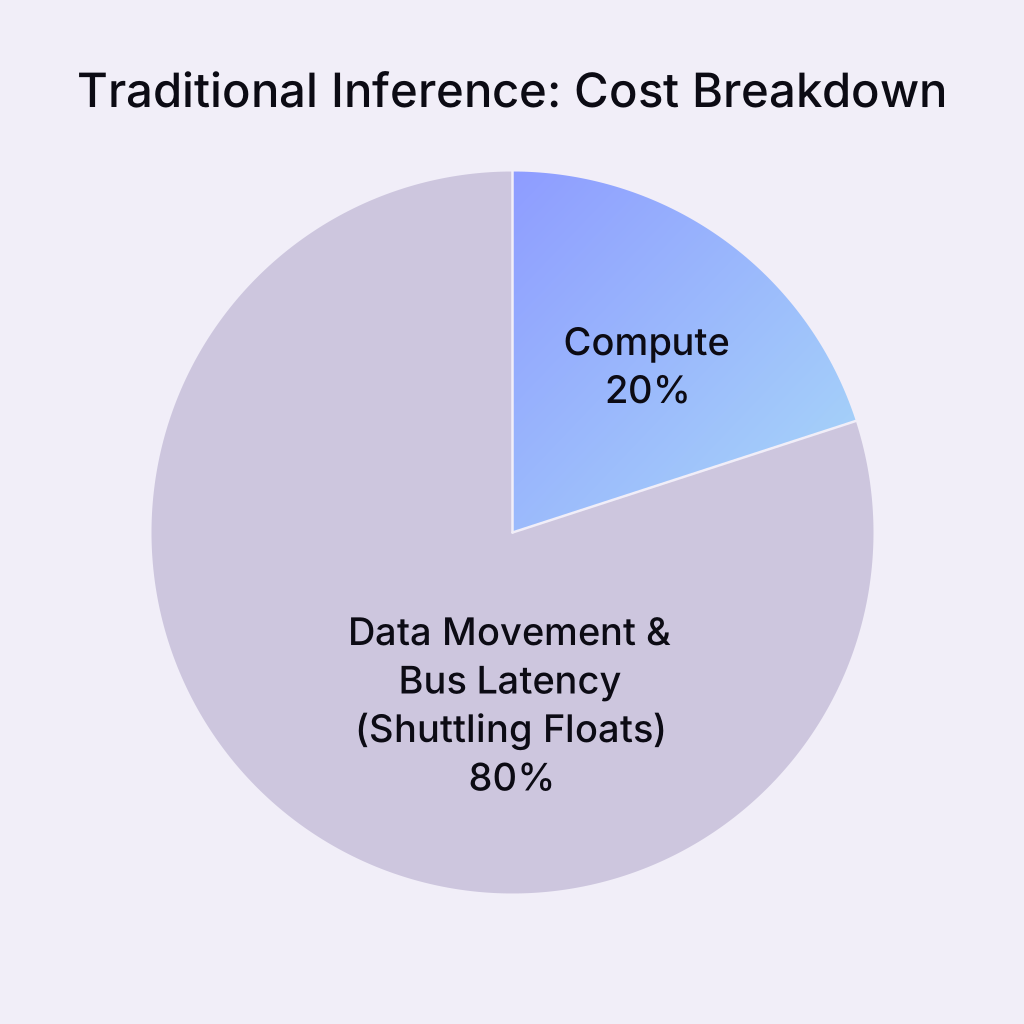
NEOMORPHIC™
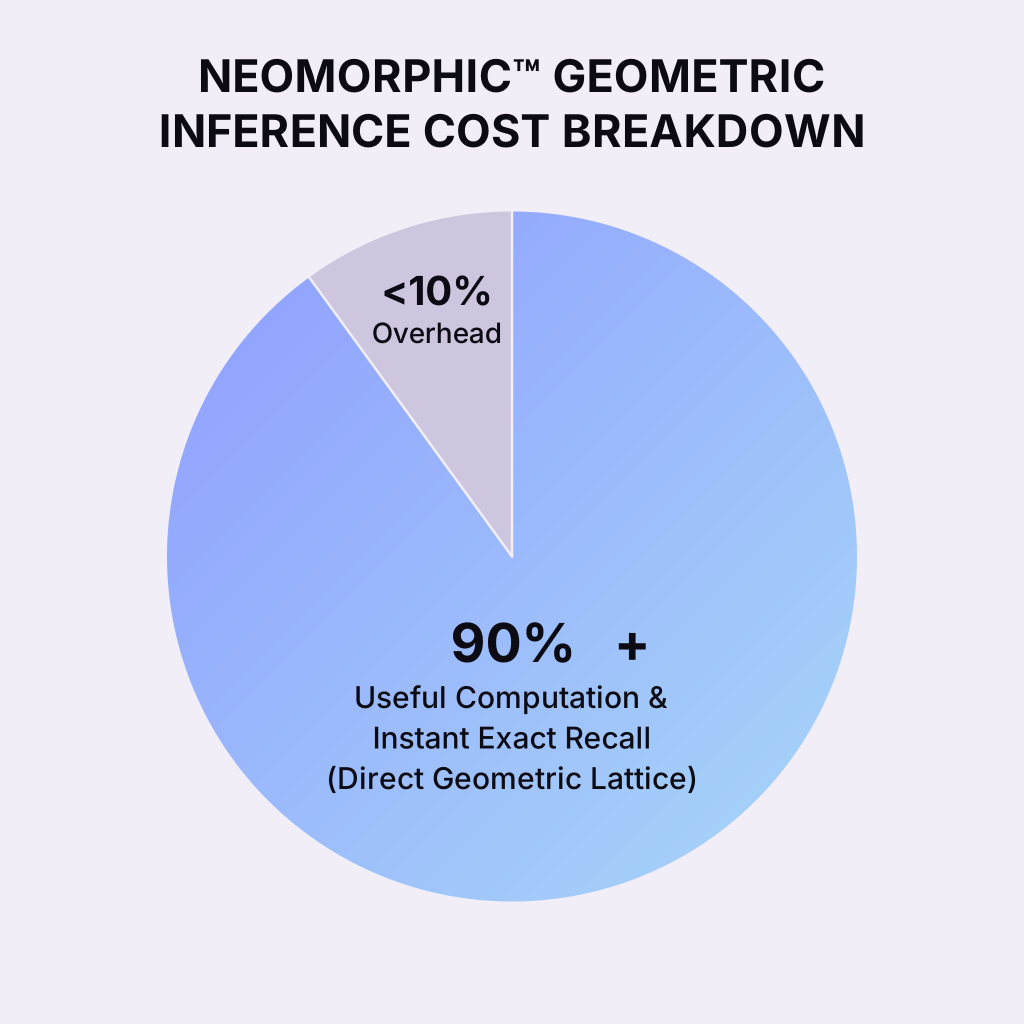
03 NEOMORPHIC™
NEOMORPHIC™ combines compact memory addressing with organized retrieval to deliver a lower cost per useful decision. Our architecture brings together efficient address storage, exact address recovery, and predictable access as memory grows.
01
2.56× address-storage efficiency in the reported catalog study.
Store the same structured addresses in approximately 61% fewer bytes than a raw 32-bit representation. Compact address catalogs reduce storage and transfer requirements while preserving every encoded address exactly.
02
Reduce the work required to reach what a system knows.
Our architecture reduces repeated data movement and memory-access overhead, delivering a lower cost per successful decision and allowing more useful work from available computing resources.
03
Recover the stored address precisely.
Our lossless representation reconstructs the original address catalog exactly. This provides a precise foundation for persistent memory systems that need to return reliably to specific stored information.
04
Keep the path to memory short as capacity grows.
Our addressing architecture executes a two-hop lookup path within a defined memory domain, delivering predictable access to larger memory systems with lower retrieval overhead and energy requirements per access.
04 NEOMORPHIC™ Platform
01
Intelligence that builds on what it knows.
The NEOMORPHIC Mind is built around persistent memory and structured recall, allowing knowledge to remain available across interactions, tasks, and sessions.
Our focus is continuity: preserving relevant information, retrieving the records a task requires, and giving reasoning systems a dependable foundation of prior knowledge. This architecture eliminates memory-related errors and the repeated work of rebuilding context.
Ultra Super Intelligence, or USI, is our flagship intelligence architecture: intelligence that accumulates knowledge, supports increasingly complex work, and remains economical to operate.
02
Improve how information is stored, addressed, and moved.
Our holographic memory and fractal data organization represent information geometrically for direct, high-speed access. Structure-aware compression complements that architecture by reducing the bytes required to encode memory-address catalogs while preserving their exact reconstruction.
Together, these capabilities deliver lower storage requirements, reduced data movement, and more efficient access to persistent knowledge.
This directly improves the core memory operations that govern application cost, bandwidth demand, and energy consumption.
03
Secure information across connected systems.
Our security architecture uses lattice-based post-quantum cryptography for device identity and protected communication, alongside strict controls governing access to stored information.
Applications span servers, laptops, smartphones, and distributed device networks.
NeoBlockchain™ extends this architecture into distributed ledgers, using compact data representation and secure communication to reduce memory, transmission, and energy overhead while preserving full transaction verification.
04
Connect software innovation with evolving hardware.
LUV Language™ is our proprietary programming language and compiler, built to connect NEOMORPHIC capabilities across computing architectures.
It provides a unified framework for memory, intelligence, and secure computation—executing on today’s digital hardware with a direct roadmap to future photonic computing systems.
LUV makes the platform straightforward to implement, extend, and deploy as computing hardware evolves.
Commercialization Strategy
NEOMORPHIC™ operates a commercialization strategy spanning semiconductor IP, intelligence software, and connected systems.
Our revenue model encompasses chip and device royalties, recurring software licenses, and integration and support services—delivering proven capabilities that manufacturers and platform providers can incorporate directly into their products.
Target markets span enterprise AI, consumer devices, robotics, industrial systems, satellites, and aerial infrastructure.
04 Benchmarks
99.9 %
Methodology
(Company-reported, 100 trials / 7 bindings internal)
13.834 µs
Methodology
(Median local recall)
0.235 ms
Methodology
(Median, M4 Pro)
3.2 x
Methodology
(68.75% fewer representation bytes; cosine similarity 0.995)
2.34 M/s
Methodology
(Batch size: 8,192)
99.98 %
Node Uptime
Methodology
Optimal / 99.98% Node Uptime
All values are company-reported benchmark results. Chart shapes marked “Illustrative” are decorative and do not represent additional data.
Every number below is measured on production hardware. No simulation. No theoretical upper bound.
The write path bypasses full-cycle arithmetic transforms, reducing operations per transaction by 96.31% without sacrificing archive fidelity. Sustained write throughput exceeds 10,000 operations per second on edge-class processors.
Active traces and subband windows are sized to fit entirely within L1 and L2 processor caches. Main-memory bus latency and DRAM page conflicts are eliminated by design, not by optimization pass.
Write-ahead logs use additive complex deltas rather than full-state snapshots. A 100,000-transaction log is fully restored in under 15 milliseconds — a 99.07% reduction in recovery-phase arithmetic operations.
Rotational phase shifts are isolated from amplitude metrics at the architectural level. Phase errors do not compound across reasoning hops, ensuring stable multi-hop compositional accuracy regardless of chain depth.
Conventional holographic memory saturates logarithmically as archive depth grows. SSII replaces winner-take-all decoding with a tail-average margin comparison, shifting the saturation boundary to a continuous linear scaling model. Storage capacity scales with archive depth, not against it.
Full-stack operation — including write, recall, and archive maintenance — runs within a 5.0-watt thermal design envelope. Compatible with resource-constrained edge hardware and mixed-signal optoelectronic substrates.
06 Humanity & Mission
01
Advance biological research, medical cures, and age-reversal science.
Ultra Super Intelligence (USI) is built to power the next generation of biological research, gene therapy, and synthetic biology (SynBio), accelerating research toward medical cures and age-reversal technologies.
Scientists move toward discovery faster and with greater confidence, backed by persistent research memory, precise retrieval, and traceable scientific evidence.
02
Intelligence built to serve as a watchdog against malevolent AI.
NEOMORPHIC™ is built to protect commerce, food supply chains, and essential infrastructure from malicious AI activity, manipulated information, and digital disruption.
Our intelligent systems identify threats, preserve trusted operational records, and enable teams to respond before those threats compromise essential goods and services.
03
Support the discovery of new, futuristic materials that enhance the quality of life on Earth.
NEOMORPHIC™ is built to advance materials research for robots, cars, housing, clothing, and other technologies that shape everyday life.
By connecting scientific knowledge, simulations, and experimental results, the platform accelerates the discovery of materials that make these technologies more capable, sustainable, and accessible.
04
Dependable intelligence built for situations where lives are on the line.
USI is built for national security and defense, eliminating hallucinations, fabricated information, and memory-related errors.
Secure communication, persistent memory, and precise access to stored information empower authorized personnel to make better-informed decisions when accuracy, continuity, and timely action are vital.
06 Questions & Answers
Neither. NEOMORPHIC is a different category of machine intelligence entirely — not an improvement on top of the transformer architecture, but a replacement for it.
A large language model works by predicting the next token in a sequence, using attention mechanisms that scan a sliding context window. NEOMORPHIC does not predict. It does not search. It stores structured knowledge as precise frequency-domain representations and retrieves it through an algebraic operation that is exact — not approximate, not probabilistic. The result is either the correct answer or a definitive “not found.” There is no hallucination path in the architecture.
LLMs can be called as tools — the way any skilled system might delegate a task to a specialist. But the core intelligence, memory, and reasoning live inside NEOMORPHIC. The LLM is an optional capability at the periphery, not the engine.
Yes. This is not a proposed capability — it is what the system does today, demonstrated on an air-gapped laptop with no internet connection and no access to any external model.
The sequence is observable and repeatable:
All of this happens on standard consumer hardware. No pretrained transformer is involved in any step.
Inside the architecture. Retrieval and coordination are consequences of the intelligence, not substitutes for it.
The distinction matters because the hardest problems in AI are not retrieval problems — they are reasoning problems. Knowing where to look is different from knowing what to do with what you find. NEOMORPHIC's intelligence is embedded in the relationships it builds between concepts, the patterns it identifies in novel contexts, and the adaptive behavior it exhibits when outcomes diverge from predictions. These capabilities persist without any external model providing the reasoning.
It is a new foundation. The memory architecture is the mechanism; the consequence is a fundamental change in what machine intelligence can do and where it can operate.
The memory bottleneck — the structural limitation that causes current AI to forget, hallucinate, and scale poorly — is not an engineering problem waiting for better hardware. It is an architectural problem. NEOMORPHIC solves it at the architectural level. Everything that flows from that solution — the accuracy guarantees, the energy efficiency, the sovereign operation without cloud dependency, the ability to run completely offline — are outcomes of getting the architecture right, not features bolted onto an existing design.
We call it SSII: Sovereign Symmetric Intelligence Infrastructure. It will not replace AI the way a better AI replaces a worse one. It will make the category obsolete.
A vector database stores approximate representations of data and returns statistically probable matches — the nearest neighbor in a high-dimensional embedding space. “Nearest” is not the same as “correct.” The system can retrieve something plausible that is factually wrong, with no reliable way to know the difference.
NEOMORPHIC retrieves exactly what was stored, or returns “not found.” The operation is algebraic, not statistical. There is no nearest-neighbor approximation. There is no hallucination path. The accuracy guarantee is architectural, not statistical — it holds regardless of archive size, data type, or query frequency.
The practical consequence: systems built on NEOMORPHIC don't produce confident wrong answers. In any application where a confident wrong answer is worse than an honest “I don't know” — medicine, aerospace, legal, financial — this is not a marginal improvement. It is a different operating mode.
It applies the same reasoning it uses for familiar problems — identifying structure, testing relationships, forming and refining models — without requiring a pretrained answer to already exist somewhere in its archive.
This is a meaningful distinction from retrieval-based systems, which can only return useful results when the relevant information was previously stored. NEOMORPHIC's architecture supports generalization: the ability to construct understanding of a new problem from the relationships between things it already knows.
The caveat that applies to any intelligent system also applies here: the quality of generalization scales with the breadth and depth of prior learning. But the architectural constraint that limits pure retrieval systems — no answer if the answer was not pre-stored — does not apply.
Measured on our sovereign brain implementation:
| Metric | NEOMORPHIC | Current AI alternatives |
|---|---|---|
| Memory recall accuracy | 100% (unique-role, operator benchmark) | 28–54% (published fact-recall benchmarks) |
| Hallucination rate | 0% | 5–10% (published benchmarks) |
| Recall latency | 13.834 µs isolated | 380–670 ms (API round-trip) |
| Cost per recall | $0.0000004 | $0.009–$0.020 (list-price RAG) |
| Data location | On-device | Provider cloud |
These are operator benchmarks. Competitor accuracy figures are from published SimpleQA and Vectara HHEM studies. Diligence-level independent verification is available on request.
Standard consumer and enterprise hardware today. An air-gapped demonstration runs on a laptop. Production deployments scale across existing server infrastructure without specialized hardware requirements.
The architecture is built to exploit purpose-built hardware — specifically neuromorphic chips and photonic integrated circuits — when those platforms become available in qualified form. On that hardware, energy consumption drops several orders of magnitude further and recall speed improves proportionally. The software architecture is hardware-agnostic; the hardware path is an acceleration roadmap, not a prerequisite.
The data lives on your hardware. Period. There is no transmission to a cloud provider, no model training on your data, no external dependency of any kind.
NEOMORPHIC is fully air-gap capable. In environments where network connectivity is unavailable, restricted, or adversarial — classified facilities, remote deployments, contested operational environments — the system operates identically to connected environments. The intelligence is in the device, not in a data center.
A single recall on NEOMORPHIC consumes approximately 0.03 millijoules. A single inference query routed to a cloud AI through a standard uplink path consumes 0.5–4 joules — the combined cost of transmission, cloud inference, and return. That is a difference of 110,000 to 2,200,000 times, depending on the link parameters.
This difference is not incremental. At sufficient scale or in sufficiently constrained power environments — satellite platforms, edge deployments, mobile applications — the energy gap determines what is operationally feasible. Cloud-loop AI is not merely inefficient in those environments. It is often impossible.
The error correction mathematics is real quantum error correction — real superposition, real interference operations, applied through photonic simulation. The implementation runs on standard processors using the same analog signal mathematics that govern actual photonic systems, without requiring a physical quantum computer.
The distinction matters: quantum-inspired algorithms use quantum mathematics as a design pattern implemented entirely in classical logic. NEOMORPHIC's frequency-domain architecture performs the same operations that physical photonic systems perform — the superposition, the interference, the phase conjugation — in a simulated photonic environment that produces identical mathematical results at the cost of running on electrons rather than photons. This is not a metaphor or an approximation. It is the same math, running on accessible hardware.
The photonic hardware path — via our LUV language compiler and the Quantum Light Technology photonic integrated circuit work — moves these operations onto actual photonic silicon, at which point the simulation becomes the real system.
Three deployment categories, in order of near-term revenue concentration:
Mission-critical infrastructure — aerospace, defense, and satellite applications where memory accuracy and latency are directly connected to operational outcomes. The value proposition is clear: a system that returns the correct answer in 14 microseconds, with zero hallucination, and without requiring a live uplink, is not a marginal upgrade for a satellite or an autonomous system. It is the only architecture that satisfies all three constraints simultaneously in GPS-denied, communications-constrained, or adversarial environments. Contract structures are license-based; initial deployments are priced at the division and enterprise level.
Enterprise software — businesses that need AI to work on proprietary data without cloud exposure. Current AI requires sending your data to a third party's infrastructure to get answers. NEOMORPHIC puts the intelligence on your hardware. The data never leaves the building. For industries where data sovereignty is non-negotiable — legal, financial, healthcare, government — this eliminates the primary barrier to AI adoption.
Developer platform — NEOMORPHIC ships with its own development environment. Developers build applications on the SSII substrate the way they once built applications on database and operating system platforms. The platform collects royalties on applications built and deployed on SSII.
Working today, demonstrable in person, air-gapped:
All three run on a consumer laptop. All three are fully disconnected from external models during demonstration.
The planned expansion is in deployment target, not in fundamental capability: the aerospace and defense channel, the enterprise data sovereignty channel, and the developer platform are distribution strategies for technology that is already built and operational.
Yes, in person. The standard demonstration sequence:
We bring a laptop. We disconnect it from the internet and from every external model. We show you exactly what is and is not running. Then:
The system encounters a problem it has not seen before. It works through it — identifying patterns, forming a hypothesis, executing a plan, adapting based on results. It remembers what it learned. It applies that knowledge to a different problem without being told to.
Then we open the tax application and drop in a folder of documents. It processes all of them. It doesn't compress or summarize — it retains everything. It produces a complete tax analysis, referencing specific provisions and maximizing every legitimate deduction. On the same laptop. Still air-gapped.
The demonstration is built to answer the one question that matters most: does the intelligence actually live inside the architecture, independent of everything else? The answer is yes. You can watch it happen.
The memory bottleneck.
Current AI systems are architecturally amnesiac. They process a window of context and discard the rest. They pay a quadratic energy cost as that window grows. They hallucinate because their retrieval mechanism is probabilistic — they return what seems likely rather than what is correct. They require constant reconnection to cloud infrastructure to function at all.
These are not bugs. They are structural properties of the transformer architecture. No version of a transformer — regardless of how large or how well-trained — eliminates them. They are built into the design.
NEOMORPHIC does not extend the transformer. It replaces the design. The memory it uses is algebraically exact. The retrieval is instantaneous and constant-cost regardless of how much knowledge is stored. The result is either correct or explicitly absent — there is no confident wrong answer. And the entire system operates on the hardware it is installed on, without requiring any external connection.
Every current limitation of AI — the hallucination problem, the context window problem, the energy problem, the data sovereignty problem, the latency problem — traces back to this single architectural constraint. NEOMORPHIC addresses it at the root.
The company builds infrastructure. The way Intel built the chip that ran every PC, or the way AWS built the cloud that runs most of the internet — NEOMORPHIC has built the memory substrate that future intelligent systems run on.
This is not a better AI product. It is the layer below AI products. Applications get built on top of NEOMORPHIC the way applications are built on top of operating systems and databases. The value accretes at the platform level, not at the application level — and the platform is the part that is hardest to replicate, because it is a mathematical architecture, not a collection of trained weights.
We are not competing with OpenAI or Anthropic for the best language model. We have built the infrastructure that makes the question of which language model to use irrelevant.
NEOMORPHIC™ is operator product branding. Performance figures are operator-measured benchmarks. Competitor figures are from published academic and industry sources. Independent verification available under NDA.